Sound Aesthetics: Why good sound is more than just flawless audio
- From the projects
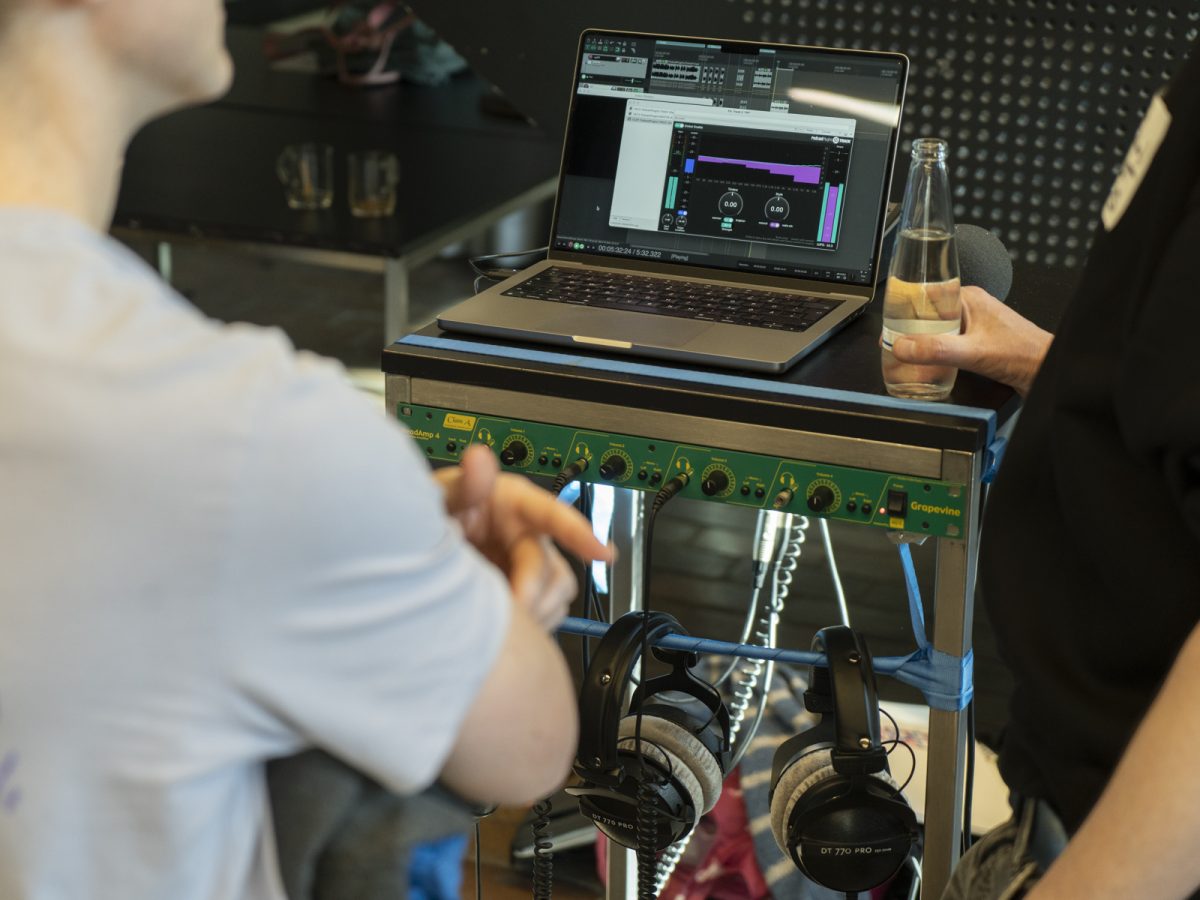
- Photo: VAYM Productions / Prototype Fund
Sound is, in fact, analogue by nature: it’s simply waves in the wind. Klaus from the BigBlueBetterAudio project discusses the question of exactly when a video conference truly sounds good.
Creak, rumble, good morning!
Just imagine: it’s Monday again, and a teacher is starting her online seminar for thirty students. Her voice sounds tinny and shrill, whilst a washing machine is running in the background. Someone else joins the call – there’s echo, background noise, and a dog. After twenty minutes, everyone has a headache; nobody has really been listening, let alone learnt anything.
This problem isn’t unique to BigBlueButton, one of the most widely used open-source video conferencing and e-learning platforms. BigBlueButton is used in educational settings, in public administration and for private purposes: wherever people want to communicate in compliance with the GDPR and value data sovereignty. Although BigBlueButton is technically on par with commercial alternatives, compromises have sometimes had to be made in terms of audio quality up to now. But what does ‘good audio quality’ actually mean? Where does technology end and aesthetics begin?
Technical quality and sound aesthetics
For me, a video conference sounds good when you can understand the content effortlessly and the sound doesn’t stand out in a negative way. That may sound like a minimal requirement at first, but it is actually quite demanding to achieve.
For a video call to work, technical audio quality is essential: signals must be transmitted without loss, latency must be tolerable, and connections must be stable. That in itself is a considerable challenge – and for many platforms, that’s where the work ends.
However, that’s not enough for productive discussions and online lectures. Anyone spending four hours a day on video calls should not only be able to communicate somehow, but also feel comfortable and be able to concentrate on the content. This is an aesthetic requirement: audio signals must not only be transmitted technically correctly and in full from person A to B and C, but ideally, voices should be reproduced in detail, whilst background noise, for example, is not processed at all.
Three processes create a soundscape
In BigBlueBetterAudio, the audio passes through a signal chain based on my many years of experience as a music producer and sound engineer. The audio signal is optimised for speech transmission in three steps:
1. Voice Isolation: Isolating speech
Our brains filter out background noise in real time – microphones cannot do this. Once the sound has been recorded, the voice and ambient noise are initially mixed together.
The first step in BigBlueBetterAudio is therefore effective voice isolation based on RNNoise, an established machine-learning model. It separates speech from background noise and is infinitely adjustable so that the result doesn’t sound too artificial. This step lies at the intersection of technology and aesthetics: the voice itself is not altered; it is simply isolated.
2. Spectral Balancer: Automatic frequency correction
Now it becomes purely aesthetic. The audio passes through the Spectral Balancer – a process I developed for automatic frequency correction. Put simply: shrill voices become warmer, whilst muffled voices become clearer. The sound becomes rounder, more pleasant and more present.
This works automatically and in real time. You can find out exactly how in the technical documentation for BigBlueBetterAudio.
3. Multiband Compressor: Dynamics under control
The final stage is a multiband compressor that I programmed myself. It divides the audio signal into eight frequency bands (put simply: bass, midrange, treble), which are compressed independently of one another – using carefully selected time constants and compression curves. The aim: sudden loud laughter, explosive sounds and sibilants are gently dampened, whilst the natural sound of the voice is preserved.
Finally, a safety limiter ensures that no distortion occurs due to signals that are too ‘loud’.
The aesthetic lies in the details
The combination of these processes and their fine-tuning results in the sound – the aesthetic. Short attack times, look-ahead and smooth compression curves ensure that extreme peaks are levelled out before they become audible. This makes the speech sound smoother and more controlled.
By way of comparison: in an aggressive pop music production, you’d want exactly the opposite – maximum energy through long (hard) attack times and high compression ratios, so that the voice virtually ‘shouts’ at the listeners. The same tools, a completely different aesthetic.
And because I’m often asked this: no, not all voices end up sounding like Beyoncé. The individual character of each voice is, of course, preserved – but it’s simply optimised for transmission, rather than rendered technically neutral.
With the latest version 4.0, BigBlueBetterAudio has been included as standard in BigBlueButton for a few days now (and also for a while in LaSuite Meet, the French Ministry of Digital Affairs’ video-calling software, as part of an open-source stack for digital independence). This marks a major step towards ensuring that open-source video-conferencing platforms not only work technically, but also feel good to use. Participants should be able to focus on what really matters: the content, the communication, the human connection.
Do pay attention to this during your next video calls – or perhaps not, because ideally BigBlueBetterAudio will be working in the background and you won’t even notice it :)
Klaus Scheuermann he/him
Klaus Scheuermann works as a freelance music producer and mastering engineer in Berlin. He has also been developing open-source audio software since 2018.
Photo: Yannes Kiefer